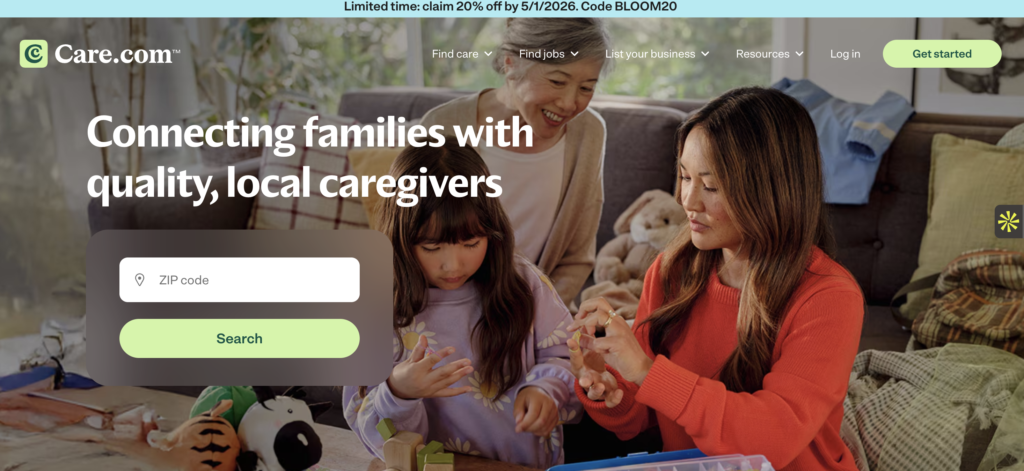
If you are placing candidates in client homes the 2020 settlement between Care.com and California prosecutors is required reading.
Care.com Background Check Settlement 2020
In July 2020, San Francisco District Attorney announced a $1 million settlement with Care.com over alleged misrepresentations about its background check products and its subscription practices.
The case alleged that Care.com falsely portrayed that its background checks included a search of the National Sex Offender Registry, which is available only to law-enforcement officials, and that its higher-priced background checks provided a more robust examination than the lower-priced ones.
Under the terms, Care.com agreed to pay $700,000 in civil penalties and $300,000 in restitution to California customers who had purchased its higher-priced background checks. The company was barred from making certain claims about its screening going forward and was required to add new disclosures.
Care.com, in its public statement, maintained that it had “always appropriately described the comprehensiveness” of its products and noted that it had voluntarily made changes prior to the settlement.
Care.com wasn’t the only major player that made a mistake like this. This “preliminary screening” has become the default across much of the gig-economy care sector. Families assume the platform has done real vetting; the platform assumes families will. The result is a screening gap that only becomes visible after something goes wrong. For any organization placing workers in homes it’s critical to understand a real FCRA-compliant background check protects a company’s liability.
You can read the official coverage from CBS San Francisco here: Care.com Settles Lawsuit Claiming It Misrepresented Background Checks.
Mistake #1: Claiming a Search That Wasn’t Actually Possible
Care.com represented that its higher-priced background checks included a search of the National Sex Offender Registry, a database maintained by the FBI.
The FBI’s National Sex Offender Registry is only accessible to law enforcement. Private companies, including background screening providers, cannot legally search it. What private companies can search is the National Sex Offender Public Website (NSOPW), which is a federally maintained, multi-state public registry. Telling a parent their nanny was screened against “the FBI’s database” creates a level of confidence the actual search doesn’t justify.
The lesson for agency owners: Ask your screening provider, in writing, exactly which sex offender databases they search and which they cannot search. The right answer involves NSOPW and state-level public registries. If your provider’s marketing implies otherwise, that’s the same gap prosecutors flagged.
Double Check What Claims You are Making
This is the broader pattern underneath both specific allegations: words like “comprehensive,” “thorough,” and “premier” doing a lot of work that the underlying product couldn’t fully back up.
The lesson for agency owners: Audit how you describe your own screening process to families. Read your website, your intake materials, your sales scripts. Anywhere you use a word like “comprehensive” or “rigorous,” ask yourself: can I name the specific searches that justify that word? If a regulator or a plaintiff’s attorney asked you to back it up, could you?
This isn’t about toning down your marketing. It’s about making sure your marketing is supported by what’s actually in the box.
A Practical Self-Audit for Agency Owners
Take fifteen minutes this week and answer these questions:
- Can you name every search included in your standard screening package?
- Can your screening provider explain, in writing, where each of those searches sources its data?
- If you offer tiered packages, is the difference between tiers documented in technical terms (specific searches added) rather than marketing terms (“more comprehensive”)?
- Does your website language about screening match what your provider actually does?
- Are you in compliance with FCRA authorization, disclosure, and adverse-action requirements on every single placement?
- When was the last time you rescreened the caregivers you’ve already placed? Industry guidance, including from the International Nanny Association, supports periodic rescreening.
If any of these questions are uncomfortable to answer, you’ve found where to start.
In Summary
The Care.com settlement should be a warning of potential gaps that exist across the consumer-facing screening category. The shortest path to that alignment is choosing a screening provider that can answer specific questions with specific answers.
About Sure Check
Sure Check is a woman-owned, FCRA-compliant background screening company built specifically for childcare, nanny agencies, senior care, and home services. Our positioning, “built to protect your brand,” reflects how we structure every package: with the specific searches that actually catch what matters, including SSN trace, multi-county criminal, multi-state sex offender registry through NSOPW, motor vehicle records, drug testing through Labcorp and eScreen, and verification work performed by humans.
If you’re an agency owner who’d like a second opinion on what your current screening process actually covers, we’d rather have a fifteen-minute conversation about your setup than sell you something that doesn’t fit.
maggie@surecheckbackground.com
Sources
- CBS San Francisco, “Care.com Settles Lawsuit Claiming It Misrepresented Background Checks, Auto-Renewed Subscriptions” — https://www.cbsnews.com/sanfrancisco/news/care-com-settles-lawsuit-claiming-it-misrepresented-background-checks-auto-renewed-subscriptions/
- Federal Trade Commission, FTC v. Care.com, Inc. official case page — https://www.ftc.gov/legal-library/browse/cases-proceedings/carecom-inc-ftc-v
- International Nanny Association, “Nanny Background Screening” — https://nanny.org/nanny-agency-updates-nanny-background-screening/
- Federal Trade Commission Consumer Information, “Background Checks: What Job Applicants and Employees Should Know” — https://www.consumer.ftc.gov/articles/0157-background-checks-what-job-applicants-and-employees-should-know