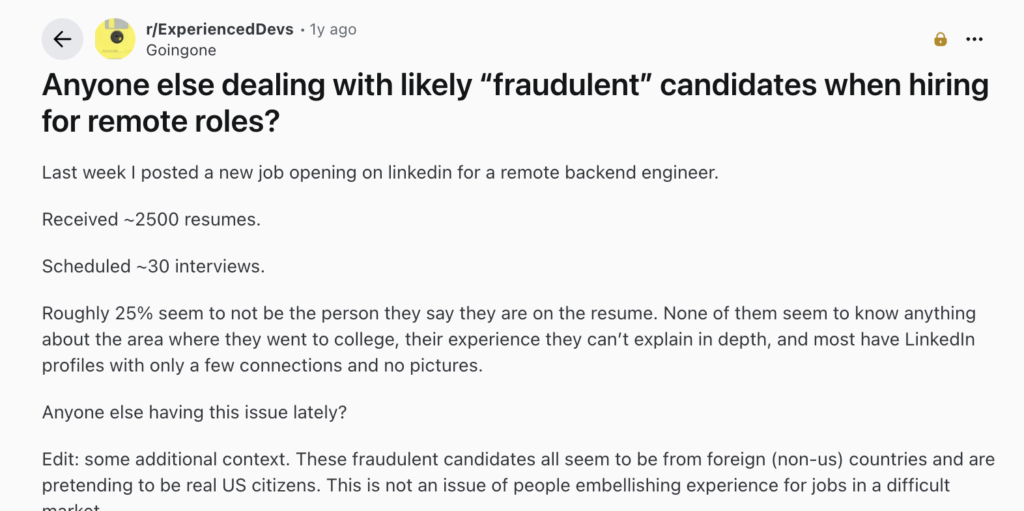
Are Your Job Candidates Fake? Here’s How to Spot Them.
How to Combat Recruitment and Hiring Fraud Hiring the wrong person is expensive. Learn how to protect your business from hiring fraud.
Sarah, a senior care operator in Texas, thought she’d found the perfect candidate. The resume looked great. The video interview went smoothly. The references checked out. Two weeks after hiring him for a caregiver role, her new employee disappeared, along with three months of salary and access to the company’s customer database.
She’s not alone. Last year, American companies lost over $501 million to job-related scams, according to the Federal Trade Commission. That number has grown by 457% since 2020. But here’s what’s really scary: One in four hiring managers say their company lost more than $50,000 to a fake employee in just the past year, according to a recent survey by Checkr, a background screening company.
The problem is getting worse, and it’s not just big tech companies anymore. Small businesses, franchises, and local employers are all at risk.
What Is Hiring Fraud?
Hiring fraud happens when someone lies about who they are to get a job. This isn’t just padding a resume or stretching the truth a little. We’re talking about serious deception:
- Using a completely fake identity or someone else’s identity
- Creating fake college degrees and professional licenses
- Making up entire work histories that never happened
- Having someone else take interviews for them
- Using AI tools to cheat through the hiring process
Remember when online dating first started? People would use old photos or lie about their age. Now imagine if someone used a completely fake identity, fake photos, and had their friend show up to the first date. That’s what’s happening in hiring today.
Why This Is Happening Now
Several things are making it easier for criminals to trick employers:
Remote Work
When everyone started working from home during the pandemic, companies stopped meeting candidates in person. That removed a huge safety check. It’s much easier to pretend to be someone else over video than face-to-face.
One staffing company in Dallas saw a huge change. In 2024, only 5% of their clients asked to meet candidates in person. In 2025, that number jumped to 30%. Why? Because companies got burned by fake candidates and they’re trying to fix it.
AI Makes Lying Too Easy
New AI tools can write perfect resumes in minutes. They can coach candidates during video interviews in real-time. They can even create fake videos of people who don’t exist. A survey of over 4,000 hiring managers found that 91% had seen candidates use AI to cheat during interviews. And almost half of tech workers admit to using AI help during job tests.
Companies Are Desperate to Hire Fast
When businesses need to fill positions quickly, they sometimes skip important steps. Background checks get rushed. References don’t get called. Red flags get ignored.
Criminals Are Getting Smarter
This isn’t random people lying on their resumes, organized crime groups are running sophisticated operations. In June 2025, the U.S. Department of Justice busted a huge scheme. A group from North Korea used stolen American identities to get jobs at over 100 U.S. companies. They caused more than $3 million in damage. Amazon alone blocked over 1,800 fake applicants from North Korea in just one year.
What It Really Costs Your Business
Losing $50,000 or more sounds bad, but the real costs go way beyond just the salary paid to a fake employee. However, before that, recruiting fees, job postings, or hours spent reviewing applications. Now that money would need to be spent all over again to find a replacement. Additionally training costs would also be wasted. All of these costs add up.
The Work That Doesn’t Get Done
Nearly one in three companies said they missed project deadlines or revenue goals because of a bad hire. When a key position is filled by someone who can’t (or won’t) actually do the work projects fall behind or fail completely and legitimate employees have to work additional hours to cover the gap and customers have a bad experience.
Legal Problems
Some industries have stricter rules around hiring. However, any business that hires someone with a fake identity, could face serious legal consequences. In healthcare, using unqualified staff to treat patients is a serious violation. In childcare, workers with undiscovered criminal records pose a potential threat to kids. In financial services, companies could end up with new hires who have fraud convictions handling money. These violations can result in fines, lawsuits, loss of licenses, and damage to your reputation that takes years to repair.
Stolen Information
Sometimes fake employees are planted specifically to steal from you. Nefarious organizations recruit them to access to valuable information. They could be after customer data or stealing trade secrets to give to competitors. By the time you discover what’s missing, they’re long gone and the damage is done.
Red Flags You Should Never Ignore
Almost half of all background checks find at least one thing that doesn’t match what the candidate told you. Here’s what to watch for:
Warning Signs in Job Applications
The Perfect Resume
- Everything matches your job posting exactly (AI can do this)
- Descriptions sound generic, like they came from templates
- No specific examples or real details about past work
- Career path seems too perfect—no setbacks, no gaps, no lateral moves
Things That Don’t Add Up
- Dates are different on the resume, application, and LinkedIn
- Can’t verify their degree or professional license
- Past employers are either too small to check or too big to get specific details
- Vague explanations for gaps in employment
Strange Timeline Issues
- Worked full-time at two different companies at the same time
- Graduated from college before they would have been old enough
- Claims to have worked somewhere that didn’t exist yet
Warning Signs Online
Only 60% of companies check a candidate’s identity as part of hiring, even though one in six companies finds fraud when they do look. Here’s what to check:
Social Media Red Flags
Check their online presence carefully before making an offer. Brand new LinkedIn profiles claiming years of senior experience are suspicious. Watch for missing profile photos or photos that look AI-generated or intentionally blurry. If their name matches someone else on LinkedIn with similar experience, you might be looking at identity theft. Search for proof they actually did what they claim—look for articles they’ve written, conferences where they’ve spoken, or certifications from recognized organizations. If someone applying for a public-facing role has almost no online presence at all, that’s a red flag worth investigating.
Warning Signs in Interviews
72% of recruiters say they’ve seen fake resumes, portfolios, or credentials made by AI, and the interview is where fakes often get caught. Technology issues are a common giveaway; candidates who won’t turn on their camera, always have “technical problems” with video, keep their background blurred, or have background noise that sounds like a call center rather than a home office. Watch for candidates whose appearance changes significantly between interview rounds. Behavioral red flags are equally telling. If someone takes a long time to answer simple questions (suggesting someone is feeding them answers), can’t explain their past work in their own words, gives answers that sound scripted and rehearsed, can’t have a normal conversation about what they know, or for technical jobs, can’t actually demonstrate their skills live—you’re likely dealing with fraud.
Warning Signs in Interviews
72% of recruiters say they’ve seen fake resumes, portfolios, or credentials made by AI. The interview is where fakes often get caught:
Things That Deserve a Closer Look
These aren’t automatic deal-breakers, but you should investigate more:
- Different names, phone numbers, or addresses on different documents
- Says yes immediately to below-market pay without any negotiation
- Gets nervous or avoids basic verification questions
- Claims they can’t meet in person due to an injury or family emergency but won’t provide any documentation
- All their ID photos look like they were taken the same day
- Asks that you not take taxes out of their paycheck
How to Protect Your Business – Fix the Hiring Process
When asked what they’d invest in to reduce fraud, companies were split between in-person meetings (36%), AI detection software (31%), and stronger background checks (24%). The truth? You need all three.
Make It Consistent
- Use the same interview questions for everyone applying for the same job
- Ask for specific examples that require detailed answers
- For technical jobs, have them do the work live while you watch
- Have multiple people interview each candidate
Get Your Managers Involved The people who actually do the job know which questions separate real experts from fakers. Use them to test technical skills.
Check Identity Early
Only 60% of companies verify identity before hiring. That’s a huge gap. Don’t be part of it.
Before You Make an Offer
- Check that ID documents are real
- Make sure information matches across all their documents
- Confirm they’re legally allowed to work
- Verify certifications and licenses with the issuing organizations
During Video Interviews
- Require cameras on—no exceptions
- Ask unexpected questions they couldn’t prepare for
- Have them explain how they’d solve real problems
- Use different interview styles (one-on-one, panel, working session)
Use Background Checks (The Right Way)
This is your best protection. 95% of employers do background screening, but not all screening is created equal.
Criminal Background Checks find a record in about 6% of candidates—one in every 17. These checks are critical for jobs with access to vulnerable people (kids, elderly, patients), financial responsibilities, unsupervised home access, or driving duties.
Employment Verification is where most lies are found. Verify start and end dates at each job, actual job titles and duties, why they left, and whether they’d be rehired. Don’t trust what candidates tell you—confirm it with past employers directly.
Education Verification is increasingly important as education lies become more common. Confirm degrees earned and when, the school they actually attended, and all professional licenses and certifications through the issuing organizations.
Reference Checks require going deeper than just calling the names they provided. Make sure references actually worked with them, ask detailed questions about specific work situations, get references from different time periods, and follow up on vague answers.
Driving Record Checks jumped from 43% to 52% of companies in just one year. Essential for delivery drivers, sales reps with company vehicles, or anyone driving regularly for work.
Drug Testing matters because 21 million Americans have at least one addiction, and people with substance problems miss two extra weeks of work per year. Drug testing is especially important for safety-sensitive jobs, DOT-regulated positions, healthcare and pharmacy work, and operating heavy machinery.
Keep Checking After You Hire
More than 75% of companies find at least one lie in a candidate’s background. Some companies now do ongoing checks after hiring for high-risk positions.
Ongoing monitoring can alert you to:
- New criminal charges
- Suspended licenses
- Lost certifications
- Sex offender registry additions
Train Your Team
70% of managers say hiring fraud doesn’t get enough attention from company leadership. Change that.
Everyone involved in hiring should know about current fraud tactics, what red flags look like, and how to properly verify information.
Smart Use of Technology
Criminals use AI to fool you. You can use it to catch them:
- Document checkers that spot fake IDs and diplomas
- Interview analysis that flags suspicious patterns
- Background check systems that cross-check multiple databases
- Software that finds inconsistencies across application materials
What’s Coming Next
The problem will get worse before it gets better. Experts predict that by 2028, one in four job candidates will be fake.
What to Do Right Now
The threat is real, but you can protect yourself:
Take These Steps Today:
- Look at your current hiring process – Where could fraud slip through?
- Train your team – Show them current fraud tactics
- Require video with cameras on – No exceptions
- Do comprehensive background checks – Don’t skip steps to save money
- Choose your screening partner carefully – Cheapest isn’t best
Protecting Your Business Starts Here
Hiring fraud isn’t just an HR headache. It’s a real business risk that threatens your money, your reputation, and your legal standing.
The good news? You can protect yourself. Good background screening, combined with awareness and smart hiring practices, dramatically lowers your risk.
What Makes Sure Check Different
We built our company around protecting your business:
We’re Fast Without Cutting Corners
85% of our basic checks are done in 15 minutes. Most finish within 24 hours. We don’t sacrifice quality for speed.
We Know the Rules Every state has different laws. We navigate that complexity for you. We’re FCRA compliant and keep you out of legal trouble.
We’re Small Enough to Care We’re a small company with big-company capabilities. You get personal service and fast responses—not automated chatbots.
Ready to Protect Your Business?
New clients: Register here to get started today.
Where This Information Came From
This article uses data from:
- Federal Trade Commission (FTC) – Job scam data for 2024
- Checkr survey of 3,000 managers – Fraud cost data for 2025
- Gartner research – Future fraud predictions
- HireRight Global Benchmark Report – Identity check statistics for 2025
- Professional Background Screening Association (PBSA) – Industry data
- U.S. Department of Justice – North Korean fraud case, June 2025
- Greenhouse hiring manager survey – AI usage in interviews for 2025
- EY employment fraud study – Sector-specific fraud data for 2025
- Multiple industry research reports on background screening market growth
Last updated: May 2026
About Sure Check Background Screening
We’re an FCRA-compliant background screening company based in Golden, Colorado. We specialize in senior care, childcare, home services, and regulated industries. We combine fast results (85% of basic checks done in 15 minutes) with thorough, state-by-state compliance. Our team has HR experience, so we understand your challenges. We offer support during business hours and after-hours for urgent needs. Built to protect your brand.
Website: surecheckbackground.com
Email: maggie@surecheckbackground.com
Phone: 773-417-6725
Register: clients.surecheckbackground.com/register/register